Viking hit a significant milestone when it surpassed 100 ships in its river, ocean and expedition fleet — the most in the industry — during a nine-vessel christening ceremony in Basel, Switzerland, on Oct. 21.
That’s an impressive achievement for a company that began 28 years ago with four modest river ships. Since then, the brand’s growth has been breathtakingly relentless.
Founded in 1997 by Torstein Hagen, who at 82 remains chairman and CEO of the company, Viking today encompasses 88 river ships, 12 ocean ships, two expedition ships and one charter ship on the Mississippi River. (Yes, that comes out to 103 ships, but Hagen admitted it’s difficult to determine which ship is actually No. 100 when so many are entering service each year.)
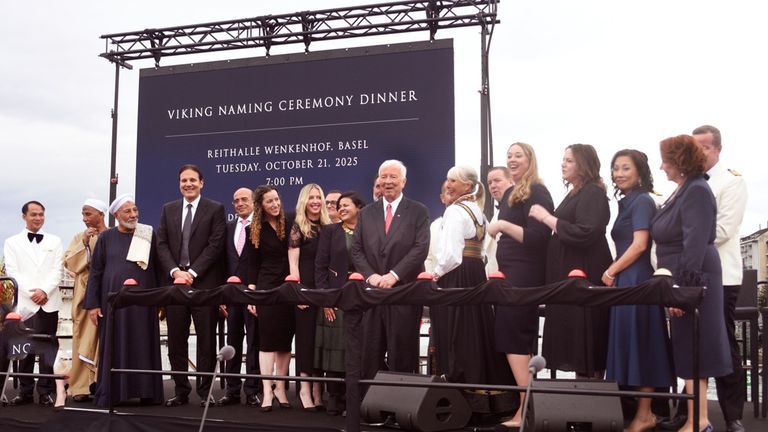 The christening ceremony stage with nine godmothers, godfathers and ship captains
Credit: 2025 Viking
After opening a Los Angeles office in 2000, Hagen aggressively promoted the company with lavish brochures, a direct-mail campaign and attractive commercials, many on public television. By his own account, he estimates he’s spent about $4 billion on marketing and advertising since the start.
"When you grow from nothing to something, you can say that's a high rate of return — it's infinite," Hagen said. “We have grown capacity from 2017 by 10.6% per year. We had revenue in total of $5.3 billion last year.”
In fact, Hagen says Viking is the third-largest cruise company in the U.S., based on market capitalization (a measure of a public company’s value) of about $27 billion. That compares to about $81 billion for Royal Caribbean Group, $36 billion for Carnival Corp. and more than double Norwegian Cruise Line Holdings Ltd.’s $10 billion, according to Hagen’s figures.
Strategy for Success
Does reaching the 100-ship fleet size mean it’s time to slow down? Not according to Hagen, who predicts growth of more than 53.3% by 2030. Viking has 31 river ships on order for delivery by 2030, including options, as well as 14 more ocean ships and options coming by 2033. The average age of the fleet is 7.2 years.
"Right now, our job is to build ships to meet the demand,” Hagen said.
Hagen adds that Viking’s product is tailored to its clientele, predominantly made up of English-speaking North Americans, age 55-years-plus, who are well-educated and affluent.
"They have more time, disposable income and great financial resilience,” he said.
The other 10% of guests hail from the U.K., Australia, New Zealand and China. (And four Viking riverboats in Europe cater exclusively to the Chinese market, with Mandarin-speaking crews and food.)
According to Hagen, more than 77% of new-to-Viking clients come to the brand’s ocean ships from mainstream mass-market, premium and luxury lines. More than 50% of Viking’s customers are repeaters.
Hagen is very clear on what Viking is and what it isn’t. For example, he says that all its ships are virtually identical, because the ship is not the main attraction, the destination is.
“We are not a floating amusement park,” Hagen said. “We have no private islands. We like to go to real places, not artificial islands in the Bahamas.”
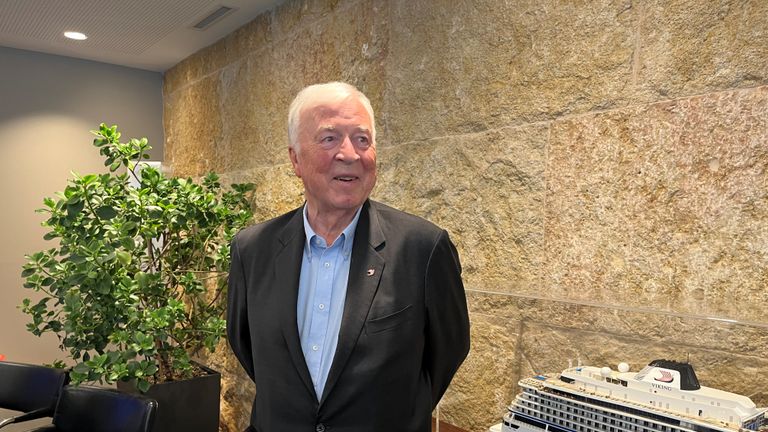 Torstein Hagen in front of an ocean ship model
Credit: 2025 Theresa Norton
The identical ship layouts also let travel advisors and their clients familiarize themselves with the location and type of stateroom or suite they prefer. When river ships must stop sailing due to high or low waters, passengers can switch to another river ship on the other side of the bridge or in higher waters and be moved into the same staterooms.
“We make it easy and comfortable to travel with us,” Hagen said.
He adds that this is especially true for older clientele, citing a TV remote with just nine buttons, roomy showers with easy-to-understand fixtures, bath amenities with big lettering (so guests don’t need their reading glasses in the bathroom) and more.
What Viking doesn't have is just as important to its strategy: No children under 18, no casinos, no nickel-and-diming, no charge for beer and wine at lunch and dinner, no umbrella drinks, no charge for alternative restaurants, no photography sales or art auctions, no inside staterooms, no smoking, no lines, no formal nights or butlers, no entrance fee for the spa and no charge for using the onboard launderettes.
With the majority of Viking’s river ships on European waterways, the industry might wonder if Hagen is at all concerned about new entrants, such as Celebrity Cruises, which announced plans for two 86-stateroom riverboats on the Rhine and Danube rivers by 2027 (and an eventual 10-ship fleet).
"It’s their decision,” he said, noting that Viking has control of or priority access to 110 river docking locations in Europe. “As newcomers [enter the market], they will probably have to go to secondary ports.”
As to Viking’s phenomenal growth, Hagen says it comes down to “perseverance — never give up.”
