I stood alone at the edge of a lukewarm pond, my toes sinking into a slush of mud and sand, and belted out “Hy-dra!” as loud as I could.
I wasn’t summoning the lake serpent of Greek mythology; I was calling a capybara that I had met a few nights prior at a Guyanese wilderness lodge, hoping she’d join me for a swim.
Within seconds, I noticed ripples shoot across the top of the otherwise glassy pond. I squinted to get a better look and saw a tiny head inching toward me. It was Hydra.
I slinked into the water and sat down, reaching my hand out to offer her a welcoming chin scratch. She instead climbed onto my lap and began making a rumbling purr, cuddling up for a bit of affection as the water lapped on my side. Without warning, two other capybaras appeared and came over to say hello, giving me — and Hydra — a few nudges before heading up on the shore to snack on grass.
This was the very reason I had come to Guyana.
Welcome to Guyana
Before arriving, I had little knowledge of the country, despite having relatives from the capital city, Georgetown. I knew it was South America’s only predominantly English-speaking country, and I had tried a few Guyanese dishes before. Still, like many first-time visitors, I was a blank slate.
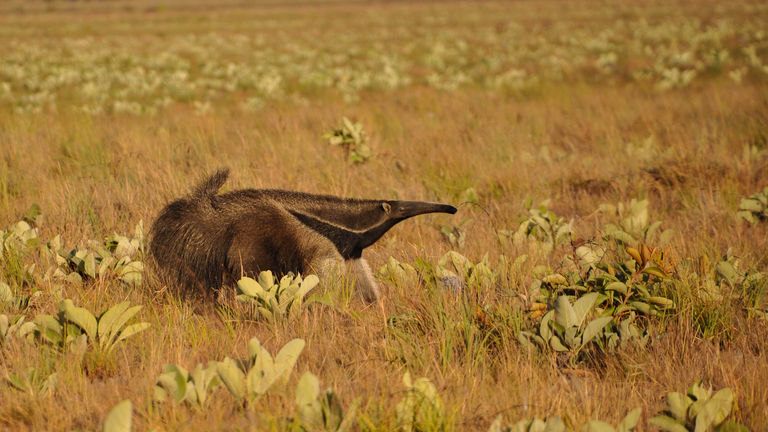 Guyana is home to hundreds of species of mammals, including giant anteaters.
Credit: 2025 David DiGregorioGuyana is often overlooked in favor of better-known destinations in South America, such as Peru and Brazil, despite having equally impressive natural attractions. But it’s precisely the type of place to propose to clients who feel like they’ve “seen it all” — especially if they’re fond of nature.
Travelers with an organic interest in the country are often birders, as Guyana has long been known for its birdwatching excursions. Guyana has more than 820 bird species, from the mohawked cock-of-the-rock to harpy eagles. Lucky clients may even spot the red siskin, a rare bird that was once widely poached so it could be crossed with canaries to create red canaries. However, it’s not just avian species that draw in wildlife-watchers; Guyana is also home to hundreds of species of mammals, from the famously ferocious giant river otter to majestic giant anteaters.
The Rupununi Savannah
I devoted much of my time in Guyana to exploring the Rupununi savannah, a vast grassland that stretches alongside much of southwestern Guyana, particularly along the borders with Venezuela and Brazil. I spent my first night at Saddle Mountain Ranch, a working cattle ranch where guests can learn about local ranching culture or take a break-of-dawn safari to see giant anteaters, which can reach up to 8 feet from nose to snout.
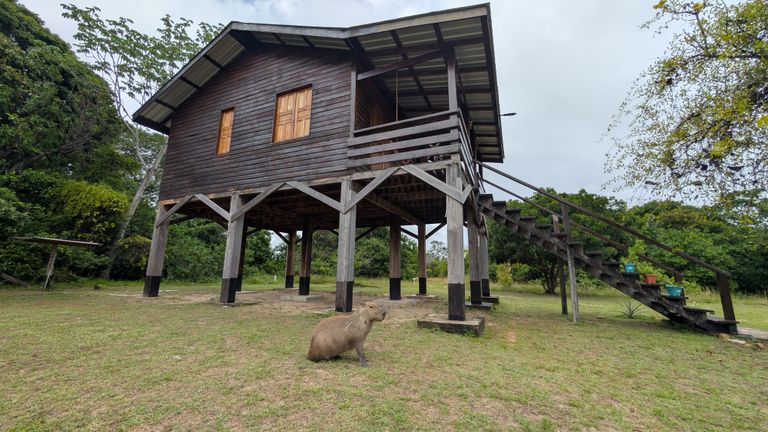 Travelers can enjoy swimming with capybaras at Wichabai Ranch, located in South Rupununi.
Credit: 2025 Margot BiggI then headed to Wichabai Ranch and Guests Houses in the heart of the South Rupununi with one thing on my mind: swimming with capybaras. It was here I first met Hydra, the friendliest of a trio of resident (but non-captive) capybaras, who had been rescued from hunters and bottle-raised. Capybara rehabilitation is just one of many wildlife-protection programs run by the South Rupununi Conservation Society, which is headquartered at the ranch.
Room rates at Wichabai include all meals and activities such as canoeing, camera trapping (capturing videos and images of wildlife with little human interference) and, of course, capybara co-swims. Clients interested in Indigenous traditions can visit nearby Katoonarib Village, where hosts from the Wapishana community teach traditional skills such as harvesting cassava and transforming it into bread.
Rainforests and Waterfalls
Guyana’s wonders go beyond the savannah. The country is home to Kaieteur Falls, one of the largest and most impressive single-drop waterfalls in the world.
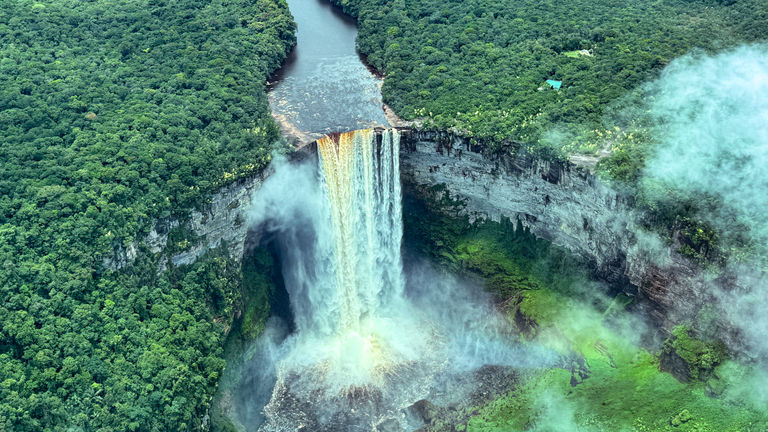 Kaieteur Falls is one of the largest single-drop waterfalls in the world.
Credit: 2025 David DiGregorio
"It’s the jewel in Guyana’s crown and almost five times the height of Niagara, yet with only a handful of visitors each day,” said Claire Thorne, director of Wilderness Explorers, Guyana’s only destination management company.
Another highlight is the Iwokrama Canopy Walkway, a 505-foot-tall rainforest walkway where early-to-rise visitors can spot toucans and monkeys from a premium perch.
Cultural Capital
While most of Guyana’s wildlife is found in its interior, around 90% of the human population lives in the capital city of Georgetown and the surrounding coastal region. While many visitors only pass through Georgetown, it’s worth spending a couple of days in the city. Wildlife-lovers can feed grass to the resident manatees at sprawling Georgetown National Park or take a sunset riverboat tour along the Demerara River to view roosting birds such as the scarlet ibis. Travelers interested in food can sample all sorts of tropical fruit on a chef-led tour of Bourda Market or sit down for a meal of Seven Curry, a platter of Indo-Guyanese specialties such as chickpeas, pumpkin, eggplant and potatoes served on a massive water lily leaf.
Getting to and Around Guyana
Guyana may feel remote, but it’s well-connected to the U.S. and Canada, both of which have large Guyanese diaspora populations. Daily direct air service connects Georgetown to New York and Miami, while Georgetown flights from Toronto and Houston, Texas, depart a few times per week. Commercial flights operated by Trans Guyana Airways connect Georgetown to Lethem in the Rupununi region, while Wilderness Adventures and other inbound operators can arrange day tours to Kaieteur Falls and charter flights across the country.
