The path toward greater sustainability in cruise travel is a winding one. That being said, some big developments are under way, and we gathered the latest sustainability news from Antarctica21, Hurtigruten, Ponant and Pelorus Yachting.
According to these lines, clients will be able to sail on a nearly carbon-free vessel as soon as December 2026, and fully carbon-free vessels may be available by 2030.
Antarctica21
In collaboration with HIF Global, an international leader in e-fuel production, Antarctica21 has become the first in the cruise industry to use synthetic gasoline for its namesake Antarctica operations.
E-fuel is made from green hydrogen and recycled carbon dioxide provided by wind energy. It is developed locally at HIF Global's Haru Oni plant in Punta Arenas, Chile. Since it is chemically equivalent to gasoline, existing engines or infrastructure do not need to be changed. This makes it a promising alternative, and moves the needle toward industry decarbonization objectives.
Antarctica21 will first test the e-fuel in zodiac operations off Magellan Explorer. The line plans to use synthetic Marine Gas Oil (e-MGO) to fuel the flagship’s main engines in the years to come. It aims to use synthetic jet fuel for air operations, as well.
"We are delighted to be at the forefront of the quest for alternative energy solutions,” said Jaime Vasquez, president of Antarctica21. “The strategic partnership between Antarctica21 and HIF aligns with our ongoing sustainability initiatives, which encompass energy-efficient practices and a comprehensive carbon-offsetting and certification program.”
Vasquez added that integrating e-fuel into the line’s operations will pave the way toward greater sustainability not only for Antarctic tourism, but for marine operations elsewhere, too.
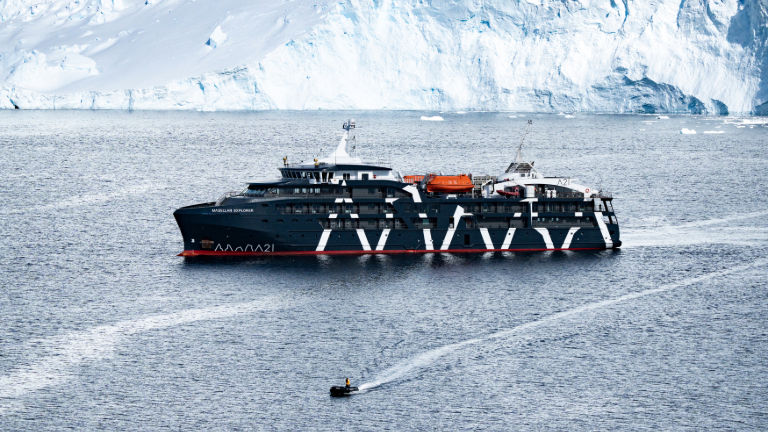 Antarctica21 is exploring the use of e-fuel.
Credit: 2024 Antarctica21Hurtigruten
Hurtigruten continues its Sea Zero project, aiming to make a zero-emission ship by 2030. The line has revealed the vessel’s latest specifications and renderings. Notably, it will be able to sail emission-free during normal operation thanks to large batteries, sails and other solutions that will potentially reduce energy consumption by 40-50%.
Sails will be able to be raised or lowered and out of the way; it is estimated that this will eventually lower energy consumption by about 10%. Another 2-3% energy savings is anticipated from solar panels. The sail type under investigation is dubbed OceanWings, and it is already in use on a cargo ship.
Furthermore, the ship will employ contra-rotating propellers, and retractable stern thrusters will optimize port maneuvering and boost safety via redundancy. Hull air lubrication will also reduce drag (for a possible energy savings of 5-10%) as air bubbles are pumped below. Water resistance can be reduced even more given the hull’s modern design, advanced anti-fouling coatings and regular cleaning.
Batteries onboard the ship will tout a capacity of approximately 60 megawatt-hours, and preliminary findings indicate that improved ventilation and insulation systems and advanced energy management can also bolster energy savings. Guests will also occupy “smart cabins” that can more efficiently control heating and ventilation with a screen in the stateroom or mobile app while away.
The cruise industry is a significant polluter, and it is crucial that we now take major steps to reduce emissions.
“The cruise industry is a significant polluter, and it is crucial that we now take major steps to reduce emissions,” said Hedda Felin, Hurtigruten’s CEO. “Our goal is to have an emission-free ship in operation by around 2030. We are still in the research and development phase, but we have made significant progress.”
Ponant
Similar to Hurtigruten, Ponant is developing its own carbon-neutral transoceanic ship with its Swap2Zero project. This vessel is also set to debut in 2030. Most recently, the line was selected for Innovfund support, granted by the European Commission and financed by revenue from the EU Emissions Trading System. It is considered one of the world’s biggest funding programs for innovating low-carbon energy tech solutions.
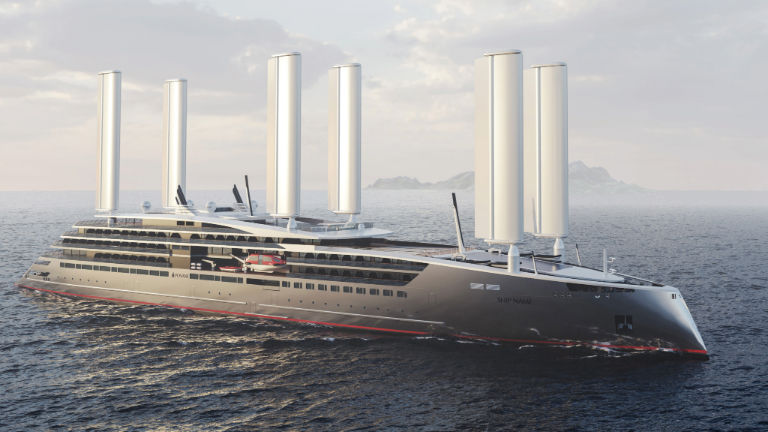 Ponant’s Swap2Zero project involves a carbon-neutral transoceanic ship.
Credit: 2024 Stirling Design International_Oceanwings“Getting this grant sends a very encouraging message to teams working on this ambitious decarbonization project,” said Patrick Augier, general secretary of Ponant. “The recognition acknowledges Ponant’s pioneering spirit. With the Swap2Zero project, we are building a showcase of French technology around the first zero-emission ship in operation.”
Ponant’s Swap2Zero project is based on half a dozen key elements: a sail power system and hull for 50% propulsion energy from wind; over 1,000 square meters of photovoltaic panels; supplementary low-temperature, liquid hydrogen fuel cell propulsion; high-temperature fuel cell hotel operations; onboard carbon-capture technology; and a custom energy management system.
Pelorus Yachting
Charter company Pelorus Yachting will soon have its own nearly zero-carbon-emission luxury yacht. Available to clients starting in December 2026, Captain Arctic by Selar will be a 230-foot polar expedition vessel for up to 30 guests. It will cruise to Norway, Svalbard and Greenland.
Like the aforementioned Hurtigruten and Ponant ships, Captain Arctic will sport solar sails, each with 2 x 100-square-meter panels. The resulting yacht will be free of noise, vibrations and odors; able to save 90% of carbon dioxide; and operable on vegetable oil whenever wind and solar power is insufficient.
All-inclusive private charters on this uniquely sustainable yacht will begin at $590,000 per week, and 5% of profits will be given to charities dedicated to Arctic protection.
