Hawaiian green sea turtles have always reminded me a little of college professors — probably because of the stern expressions they’re so often wearing. Their adorable faces just seem a little too serious for their beautiful surroundings.
Known throughout the Hawaiian Islands as honu, Hawaiian green sea turtles are listed as threatened under the federal Endangered Species Act. Still, it’s not uncommon to spot sea turtles across the state, and the reef right in front of the 32-acre Fairmont Orchid on Hawaii Island’s Kohala Coast, has long been a wonderfully consistent location to snorkel with the spellbinding sea creatures.
During my visit to the property this spring, I spotted several honu on a handful of snorkeling excursions in Pauoa Bay — located just in front of the hotel — as they munched on sea algae and occasionally rose to the surface for air.
The white-sand beach in front of Fairmont Orchid is unquestionably one of the property’s highlights, and it’s also a terrific place for children (and adults) who have never snorkeled before to familiarize themselves with the activity and then venture out to the nearby coral reef. There, they are almost certain to swim alongside all sorts of vibrantly colored fish — and are very likely to glimpse an easygoing turtle.
Wrapped-Up Renovations at Fairmont Orchid
In June, a multimillion-dollar renovation wrapped at the 540-key resort, which included upgrades to all guestrooms, the premium Fairmont Gold floor and the property’s meeting and event spaces.
Chris Sessions, director of sales and marketing for Fairmont Orchid, says the refreshed guestrooms now feature all-new furnishings.
"We added relaxed lounge seating and got rid of the traditional working desks in the rooms and put in sofas with pull-up tables,” Sessions said. “We added custom art that was inspired by our landscape. We enhanced the lighting throughout the rooms. We touched everything in the guestroom from a furnishings and finishings perspective.”
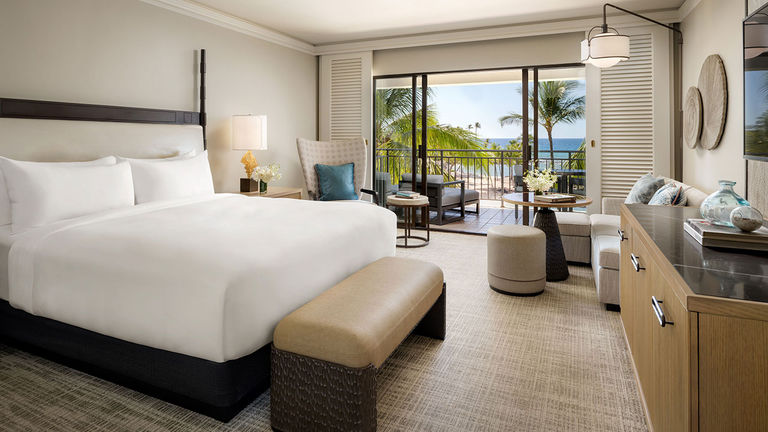 All of the resort's 540 guestrooms have been renovated.
Credit: 2025 Fairmont Orchid
Sessions notes, however, that there wasn’t a great deal done in the bathrooms.
"They’re traditional marble, so they’re timeless,” he said. “We redid all the shower doors, so that they’re new and fresh. We did all new toilets throughout and added a pop of color with new glassware.”
Having last visited Fairmont Orchid in 2022, I was impressed by the refreshed room I stayed in this spring, which featured a far more contemporary and spacious feel thanks to the updates. I suspect, though, that I — like many guests — probably most enjoyed the room’s sprawling lanai, and I tried to leave the sliding glass doors open to feel the ocean breeze as often as possible throughout my visit.
"A big focus of the refresh was bringing the outdoors inside,” Sessions said. “So, you’ll see a lot of the natural colors and elements from the exterior of Hawaii that we brought indoors. The color palette in the rooms, for example, was selected to reflect the coastline.”
Fairmont Orchid’s Reef Restoration
This spring, Fairmont Orchid also embarked on a partnership with island community members and marine conservation specialists at Arizona State University to protect and revitalize the coral reef ecosystem in Pauoa Bay.
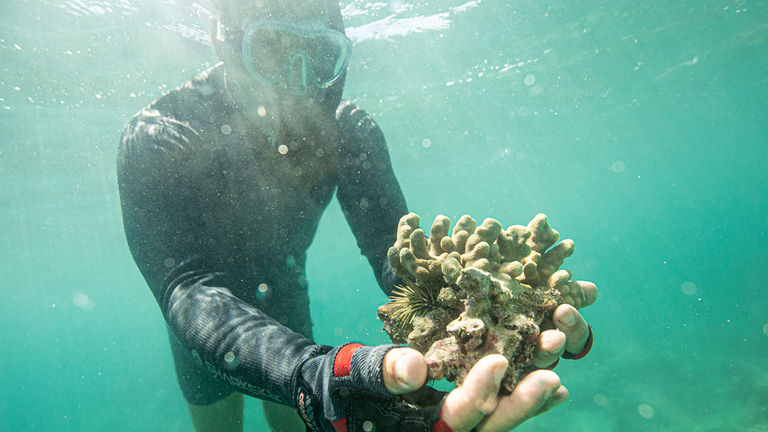 Fairmont Orchid is working to protect and restore Pauoa Bay's coral reef.
Credit: 2025 Fairmont Orchid"We have a reef restoration project where [a dive team is] going to come out and collect broken or damaged corals,” Sessions said, explaining that the removed corals will then be taken to a nursery facility in Kailua-Kona. “Once the corals get healthy again, they’re going to be reintroduced into our reef system here. It’s about a six- to eight-month cycle, where they’ll continuously collect damaged corals and then reintroduce healthy coral.”
Sessions says Fairmont Orchid operates with a sustainability-first approach and notes that guests will no longer find plastic water bottles on the property.
"We want to leave the reef in better shape for future generations,” he said, mentioning how harmful plastics can be for Hawaiian green sea turtles. “That’s why you see the honu here. They’re here because our waters are clean, and that’s very, very important for us.”
