The American Society of Travel Advisors (ASTA) presented its 2025 Travel Industry Forecast to more than 300 attendees both in person and via livestream from the National Press Club in Washington, D.C. earlier this week, providing a year-to-date tourism business update and an early look at stakeholder expectations for 2026.
Following are the biggest takeaways to know.
Outbound U.S. Travel Is Booming
Zane Kerby, ASTA’s president and CEO, said in his remarks on Monday that the number of U.S. outbound travelers has surpassed pre-pandemic levels, with more than 107 million Americans leaving the country last year, an increase of more than 8.5% over 2019’s totals.
Kerby also said outbound U.S. traveler figures have continued to grow so far in 2025.
“Despite tariffs and political posturing — which can have a negative effect on how Americans feel like they're going to be welcomed abroad — every month since tariffs were announced this February, outbound travel has increased from 2024 levels,” Kerby said. “And in June, nearly 12 million Americans went abroad. That's up more than 10% from 2024.”
Kerby indicated that most ASTA members have seen business improve in 2025.
“We've polled ASTA members three times in the past six months,” he said. “We asked them to weigh in on tariffs and other public policy decisions, and there was great trepidation in February and March. But I'm really happy to report that, over the ensuing months, that initial fear has subsided. And the vast majority of businesses are reporting growth — not everyone, but most.”
Virtuoso Advisors Are Excited About 2026
David Kolner, executive vice president of strategic communications at Virtuoso, said in his National Press Club presentation on Monday that his organization’s recently released 2026 Luxe Report annual survey revealed that the consortium’s advisors are very optimistic about vacation business next year.
“Sixty seven percent of Virtuoso advisors are predicting an increase in travel demand next year,” Kolner reported. “It's a huge number. So, [we have] a very optimistic outlook for what travel is going to look like next year.”
Kolner added that family travel is one of the top vacation motivations Virtuoso unearthed in its recent advisor survey.
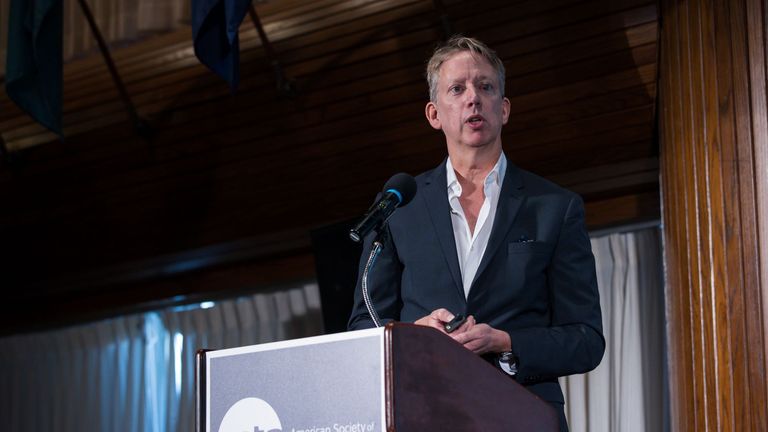 Virtuoso’s executive vice president of strategic communications David Kolner said most of the consortia’s travel advisors are very optimistic about 2026.
Credit: 2025 ASTA“A recurring trend that we're seeing at Virtuoso is that travelers are going back to immediate family travel,” he said. “They actually just want to spend time in their close-in, close-knit family unit."
Kolner also noted that in Virtuoso’s 2025 Luxe Report, the consortium found that bookings with travel advisors increased more than any other method of booking for U.S.-based consumers.
We estimate that there are 13.3 million people in the United States looking to work with a travel advisor, fueled by firsthand experience, specializations and the ability to create bespoke trips.
“We estimate that there are 13.3 million people in the United States looking to work with a travel advisor, fueled by firsthand experience, specializations and the ability to create bespoke trips,” Kolner said.
‘News Is My Biggest Challenge'
ASTA’s 2025 Travel Forecast event also featured a pair of panel discussions, including commentary and insight from several leisure travel leaders, who had a chance to talk about hurdles the travel industry now faces.
Moderated by Eric Maryanov — president and CEO of Los Angeles-based All-Travel and ASTA Board vice chair — the panel focused on how the news that clients consume these days can be a substantial issue for travel sellers.
“News is my biggest challenge,” said Amanda Klimak, president and co-owner of Largay Travel in Waterbury, Connecticut. “Everyone's getting different news. And I think for advisors, we never know what the news is that our clients are reading. So, it becomes a bit of a challenge when you're asked questions about the world, travel and everything it affects. … And so, we try to kind of pull out what people are reading and seeing and are concerned about and then pivot from there.”
Joshua Harrell, chief revenue officer for WorldVia Travel Network, agreed that news — and information in general — is now a substantial hurdle for advisors.
“Before, you would tune into the news, and you knew which channel was going to give you that point of view,” Harrell said. “Now, we're all being fed based on what we’re consuming. You like an AI cat video, and you get one take on a story, where I might be getting a completely different take on it. So, it's navigating that information, as well as where do I go for the right information? We can't play psychic, but we try. And it becomes an analysis paralysis. There’s too much information.”
Artificial Intelligence was another recurring theme during the panel discussions, and while insisting that AI will never replace the authentic insight and personal touch of advisors, many of the panels’ experts encouraged travel sellers to embrace AI as a time-saving tool.
 Travelsavers CMO Nicole Mazza encourage travel advisors to embrace time-saving AI tools during a panel discussion.
Credit: 2025 ASTA Advisors need to adapt today, There are a lot of really great tools on the market. We can't be afraid of them.
“Advisors need to adapt today,” said Nicole Mazza, chief marketing officer for Travelsavers. “There are a lot of really great tools on the market. We can't be afraid of them. You need to understand they are there to assist you in your business, to grow your business, assist with what you're doing. Nothing is going to take away your authenticity. … And you can get three to four hours back in your day if you use these tools properly. We believe advisors who are not understanding how to use AI, who are not embracing it as an opportunity within the operations of their business, are going to fall little bit further behind.”
ASTA’s Legislative Agenda
ASTA held its Legislative Day event on Wednesday, bringing travel advisors, supplier partners and industry advocates from across the country to Washington, D.C., to meet in person with policymakers on Capitol Hill. This legislative session, ASTA has three bills it’s encouraging lawmakers to support.
The Flight Refund Fairness Act (H.R. 5556) requires airlines to reimburse the ticket agent merchant of record within seven days of a flight cancellation — after which agencies would have seven days to return those funds to their clients.
The ACPAC Modernization Act (H.R. 5663) adds a ticket agent representative to the Department of Transportation’s Aviation Consumer Protection Advisory Committee (ACPAC), which evaluates consumer protection programs and advises on new policies. ACPAC does not currently include the perspective of travel advisors.
The Modern Worker Empowerment Act (H.R. 1319/S. 2228) addresses inconsistent federal definitions of worker status, which ASTA says create uncertainty for businesses and independent contractors. ASTA said in an Oct. 6 statement that more than 200,000 independent contractors work with travel agencies nationwide, and H.R. 1319/S. 2228 would better define independent contractors under both the Fair Labor Standards Act and the National Labor Relations Act.
“This clarity would protect the strong entrepreneurial opportunities that exist in the travel advisor industry while reducing litigation risk and compliance costs,” ASTA said in the statement.
